Showing posts with label fish. Show all posts

Wednesday, December 18, 2019

How to extract microplastics from fish guts

Some months ago we investigated the microplastic concentration in three commercial fish from the coast of Lima, Peru (De-la-Torre et al., 2019). In general terms, our results indicated that carnivore fish accumulate more microplastics than planktivore fish. This suggests that microplastics could biomagnify along the food chain, as previous results researching the common prey of these species, like chitons and intertidal bivalves, contained microplastics in their soft tissues. 
Indeed, some interesting results, although more and broader research is needed.

The method used to assess microplastic abundance in fish guts followed a simple procedure, as described in Fig. 1. 

Fig. 1. Procedural steps for extracting microplastics from fish guts

Stomach and intestines were extracted and placed in 25 ml glass screw cab test tubes and filled with 10% (w/v) potassium hydroxide (KOH), shaken for a few seconds and heated at 60 °C over 24 h. Following digestion, the supernatant solution was vacuum filtrated through a 20 – 25 µm pore glass fiber filter paper (Whatman) in an 8 cm in diameter porcelain Büchner funnel. Finally, filters must be observed under a stereomicroscope. 
It is absolutely necessary to conduct quality control measures. In this case, all glass and other materias must be rinsed twice or thrice with distillated/Ultrapura/deionized water. Cotton lab coats and gloves must be worn at all times and surfaces must be wiped clean. If possible, conducting the procedure under a fumehood. Quality assurance by having an airborne procedural blank by placing a wet filter on a petri dish for as long as the duration of the laboratory analysis and scan it under a stereomicrospe. The number of airborne microfibers contaminating the blank must not exceed 2 MP/blank. Also, 10% KOH alone must be vacuum filtrated and scanned to determine external contamination reached the KOH. 

References
De-la-Torre, G.E., Dioses-Salinas, D.C., Pérez-Baca, B.L. & Santillán, L. (2019). Microplastic abundance in three commercial fish from the coast of Lima, Peru. Brazilian Journal of Natural Sciences, 2(3), 171-177. https://doi.org/10.31415/bjns.v2i3.67 

Sunday, December 1, 2019

Amberstripe scads ingest microplastics resembling their copepod prey

A research published in 2017 aimed to compare the size and color of microplastics and copepod species found in surface waters and in the digestive tract of Decapterus muroadsi captured along the coast of Rapa Nui. 
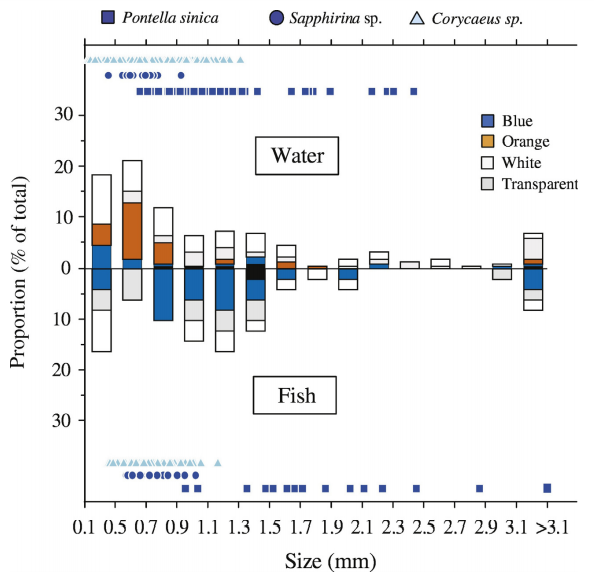
Although the majority of the microplastics in the medium (surface water) were orange, a high abundance of blue microplastic fragments were found in D. muroadsi digestive tracts. Statistical analysis indicated a significantly different selectivity among microplastics of the four colors found in the water samples. This confirmed a selectivity for blue microplastics.

Fig. 1. Size-frequency distribution (% of the total number) of microplastics (bars) of the four colors most frequently found in the 6 superficial water samples (195 microplastics in total; 6 black, 3 grey, 2 red, 2 yellow, 1 purple and 1 green particles are not shown here) and in the 16 fish that had ingested at least one microplastic (45 microplastics; 2 black and 1 green particles are not shown here). Size distributions of three blue-pigmented copepod species (scatter plots) found in the water samples and in the 20 fish that ingested copepods are shown. 

This study suggests that some fish could mistakenly ingest microplastics resembling their natural prey. 

Fig. 2. Examples of (a–f) blue microplastics in D. muroadsi digestive tracts, and (g) copepod prey Pontella sinica male, (h) Sapphirina sp. and (i) Corycaeus sp. in superficial water along the
coast of Rapa Nui (Easter Island). Scale bars represent 0.5 mm.

For further reading, check the references for the link to the full article.

References
Ory, N. C., Sobral, P., Ferreira, J. L., & Thiel, M. (2017). Amberstripe scad Decapterus muroadsi (Carangidae) fish ingest blue microplastics resembling their copepod prey along the coast of Rapa Nui (Easter Island) in the South Pacific subtropical gyre. Science of the Total Environment, 586, 430–437. https://doi.org/10.1016/j.scitotenv.2017.01.175